

What Role Do Stamping Jacket Gaskets Play in LNG and Cryogenic Applications?
2026-04-02
Why Are Sealing Systems Critical in LNG and Cryogenic Environments?
In LNG terminals, storage tanks, and cryogenic transfer pipelines, sealing reliability is not just a performance factor but a safety requirement. Equipment operating at temperatures as low as -196°C must maintain integrity under extreme thermal contraction, pressure fluctuation, and vibration. In these conditions, conventional sealing materials often fail due to brittleness or loss of elasticity.
Our engineering team has observed that sealing failures in cryogenic service are typically linked to poor material selection or inadequate gasket structure. That is why a properly designed Stamping Jacket Gasket becomes essential. It provides a combination of mechanical strength and thermal adaptability, ensuring stable sealing performance in LNG loading arms, cold boxes, and liquefaction modules.
At Ningbo Kaxite Sealing Materials Co., Ltd., our factory focuses on delivering sealing solutions that meet ASME and ASTM standards commonly referenced in North American and European markets. Our approach integrates material science with precision forming to ensure long-term sealing reliability.
How Does a Stamping Jacket Gasket Perform Under Extreme Low Temperatures?
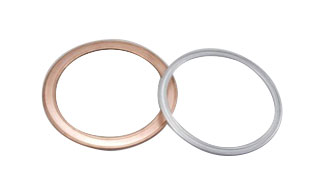
A Stamping Jacket Gasket is designed with a metallic outer jacket and a soft filler core. This composite structure allows the gasket to maintain sealing integrity even when exposed to rapid temperature drops. The outer metal layer, typically stainless steel or Monel, provides structural support and corrosion resistance, while the inner filler, such as graphite or PTFE, ensures compressibility and tight sealing.
In cryogenic applications, differential thermal contraction between flange materials and sealing components can lead to leakage paths. Our factory addresses this challenge by optimizing the jacket thickness and filler density, allowing the gasket to adapt dynamically to flange movement. This is particularly important in LNG vapor lines and cryogenic valves where thermal cycling is frequent.
Our production process includes precision stamping and forming, ensuring consistent geometry and surface finish. Ningbo Kaxite Sealing Materials Co., Ltd. has implemented strict quality control to guarantee that each gasket meets dimensional tolerances required by international EPC contractors.
What Technical Parameters Define High-Performance Cryogenic Gaskets?
Understanding the technical parameters of sealing components is essential for engineers specifying equipment for LNG projects. The following table outlines typical specifications used in cryogenic sealing systems.
| Parameter | Specification Range |
| Temperature Resistance | -196°C to +550°C |
| Pressure Rating | Class 150 to Class 2500 |
| Metal Jacket Material | SS304, SS316, Monel, Inconel |
| Filler Material | Flexible Graphite, PTFE, Ceramic Fiber |
| Standard Compliance | ASME B16.20, ASTM F36 |
Our factory ensures that each Stamping Jacket Gasket is manufactured according to these specifications, allowing seamless integration into existing LNG infrastructure. The ability to customize dimensions and materials is particularly valued by EPC contractors working on offshore LNG platforms and onshore regasification terminals.
Why Do LNG Operators Prefer Metal Jacketed Sealing Solutions?
LNG operators prioritize safety, durability, and maintenance efficiency. Metal jacketed gaskets provide a reliable sealing solution that minimizes leakage risk in critical systems such as cryogenic pumps and heat exchangers. Compared to non-metallic gaskets, they offer superior resistance to blowout and mechanical damage.
Our experience shows that operators in the US Gulf Coast and Middle East LNG projects increasingly specify Stamping Jacket Gasket designs due to their proven performance in harsh environments. These gaskets are particularly effective in applications involving flange misalignment or uneven loading conditions.
Ningbo Kaxite Sealing Materials Co., Ltd. has supported multiple international projects by supplying customized sealing solutions. Our factory works closely with clients to match gasket design with specific operating conditions, ensuring optimal performance and compliance with project specifications.
| Application Area | Recommended Gasket Type |
| LNG Storage Tanks | Graphite Filled Metal Jacket Gasket |
| Cryogenic Pipelines | PTFE Filled Jacket Gasket |
| Heat Exchangers | Double Jacket Gasket |
| Valves and Pumps | Custom Profile Jacket Gasket |
How Can Engineers Optimize Gasket Selection for Cryogenic Systems?
Selecting the right sealing solution requires a comprehensive understanding of operating conditions, including temperature gradients, pressure cycles, and media compatibility. Engineers should consider flange surface finish, bolt load distribution, and potential thermal expansion when specifying gaskets.
Our engineering team recommends conducting finite element analysis for critical sealing points in LNG systems. This approach helps identify stress concentrations and optimize gasket design accordingly. A well-designed Stamping Jacket Gasket can significantly reduce maintenance intervals and improve system reliability.
Our factory also provides technical support during the selection process, helping clients choose the most suitable materials and configurations. This collaborative approach ensures that sealing solutions align with project requirements and operational expectations.
FAQ
Q1: What Role Do Stamping Jacket Gaskets Play in LNG and Cryogenic Applications?
They provide a reliable sealing barrier that maintains integrity under extreme low temperatures and pressure variations. Their composite structure allows them to adapt to thermal contraction and prevent leakage in critical LNG systems such as pipelines and storage tanks.
Q2: Why Are Metal Jacketed Gaskets Preferred Over Non-Metallic Options in Cryogenic Service?
Metal jacketed gaskets offer superior mechanical strength and resistance to blowout. They maintain sealing performance even when exposed to rapid temperature changes, making them ideal for LNG and cryogenic environments where safety and durability are essential.
Q3: How Can Engineers Extend the Service Life of Cryogenic Gaskets?
Engineers can extend gasket life by selecting appropriate materials, ensuring proper installation torque, and conducting regular inspections. Using high-quality products from experienced manufacturers also plays a key role in achieving long-term reliability.
Conclusion
In LNG and cryogenic applications, sealing performance directly impacts safety, efficiency, and operational continuity. A well-designed Stamping Jacket Gasket provides the structural strength and adaptability required to withstand extreme conditions. Ningbo Kaxite Sealing Materials Co., Ltd. continues to deliver high-performance sealing solutions backed by technical expertise and strict quality control. Our factory is committed to supporting global LNG projects with reliable products and responsive service. Contact our team today to discuss your sealing requirements and receive a tailored solution for your application.
