

Top 10 Aluminum Alloy Antistatic Floor Solutions for ESD-Sensitive Environments
2026-11-02
When static electricity threatens sensitive electronics, the floor beneath your feet becomes the first line of defense. In this guide, we break down the top 10 aluminum alloy antistatic floor solutions for ESD-sensitive environments—from cleanrooms to server halls. You'll see why facilities managers are moving away from outdated vinyl tiles and toward high-load, fully grounded aluminum systems. We've included real-world performance notes, installation gotchas, and where Lipin Floor fits into the shortlist.
Why Aluminum Alloy Outperforms Vinyl and Steel in Static-Controlled Spaces
Vinyl surfaces, while initially cost-effective, tend to accumulate static charges through friction and routine contact, creating a persistent risk for sensitive electronics. Unlike aluminum alloy, vinyl cannot reliably dissipate electrostatic buildup without additional conductive coatings that wear away over time. This leaves cleanrooms and server environments vulnerable to sudden discharges that damage components or corrupt data.
Steel offers natural conductivity, but its weight and susceptibility to corrosion introduce other problems. In humidity-controlled static-safe areas, even minor oxidation on steel edges can alter grounding continuity, leading to unpredictable discharge paths. Aluminum alloy, by contrast, combines lightweight structural integrity with excellent inherent conductivity, ensuring consistent static dissipation without the maintenance burden of steel.
Furthermore, aluminum alloy resists the micro-abrasion that plagues coated vinyl and the rust that compromises steel. Its oxide layer, though thin, remains conductive enough for safe grounding while protecting the metal underneath. For static-controlled spaces that demand both durability and reliable electrostatic performance, aluminum alloy simply presents fewer failure points over long-term use.
Panel Coatings That Balance Conductivity With Daily Foot Traffic
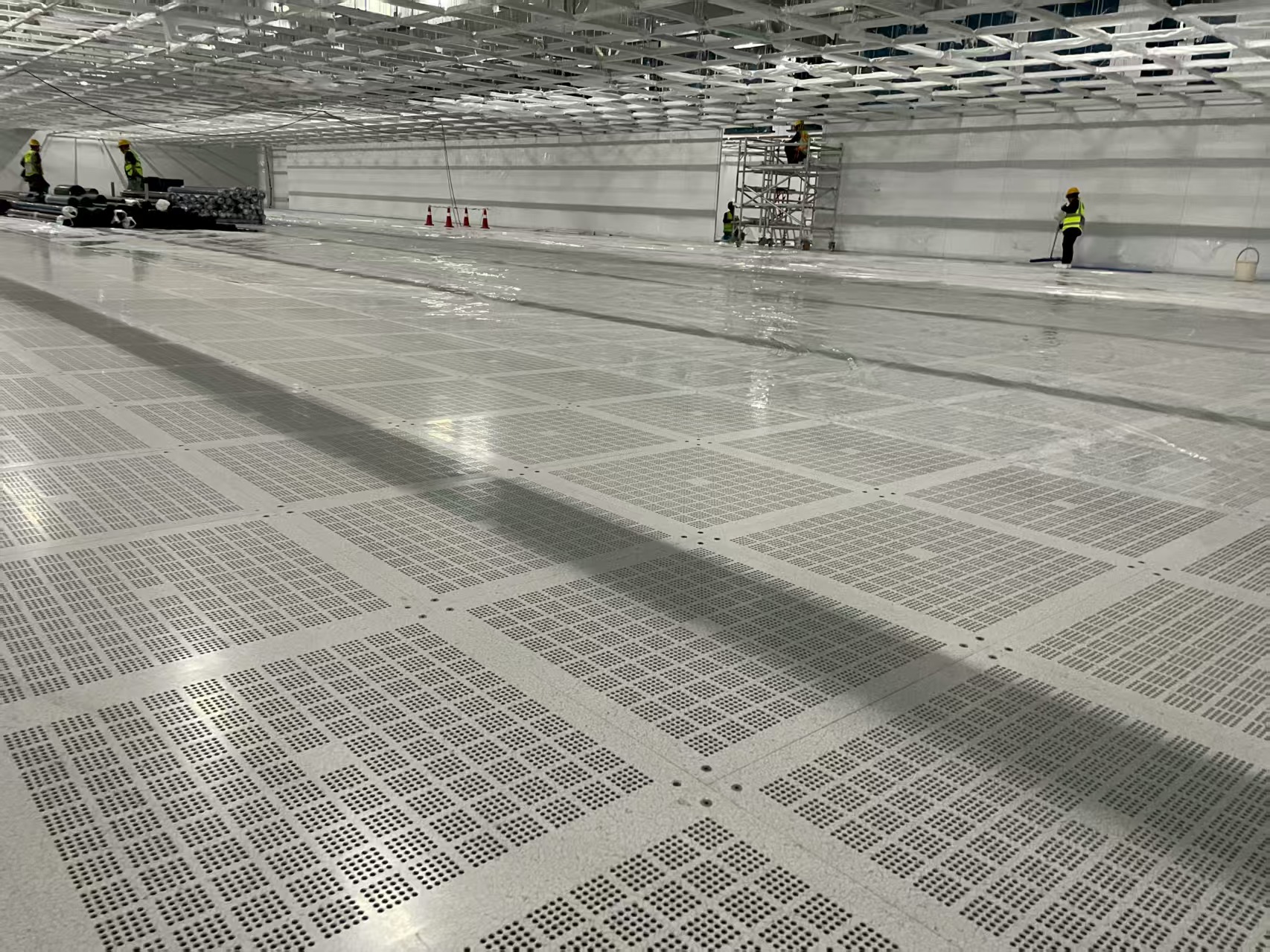
Flooring in high-traffic commercial spaces often faces a quiet tug-of-war: the need to dissipate static electricity without sacrificing long-term durability. Conductive panel coatings address this by embedding carbon or metallic fibers within a polymer matrix, creating pathways that safely channel charges while still shrugging off scuffs, chair rollers, and constant footfall. The challenge lies in tuning the blend so that conductivity doesn't come at the expense of surface hardness or color stability.
Recent formulations shift away from thick, brittle conductive layers toward thinner, cross-linked finishes that maintain a consistent ohm rating even after years of abrasion. By adjusting particle loading and dispersion techniques, manufacturers can now achieve surface resistances in the ideal range for electronics assembly areas while keeping the coating flexible enough to resist micro-cracking. This means fewer hot spots where charge accumulates quietly beneath a worn topcoat.
In practice, facility managers look for coatings that pass both ASTM conductivity tests and Taber abrasion cycles without a steep performance drop. The best options offer a matte or low-glare finish that hides scuff marks, reducing the urge for frequent recoating. When the chemistry is right, daily foot traffic actually helps polish the surface rather than degrade it, preserving the conductive network instead of grinding it away.
Grounding Layouts That Prevent Silent ESD Failures
ESD damage doesn't always announce itself with a visible arc or immediate malfunction. Often a discharge injects a fast transient into a ground net, briefly lifting the local reference and corrupting data or latching an input. These silent failures usually trace back to grounding choices that looked fine on a schematic but created high-impedance paths for the return current. A long trace from a shield connector to the chassis, a via shared between a TVS and a signal line, or a split plane under a connector can all turn a survivable strike into a field return.
The first rule is to give the ESD current a direct path to the chassis or main ground that does not wander through signal areas. At every external connector, place a chassis-ground ring tied to the enclosure with multiple vias spaced no more than a few millimeters apart. Keep the path from the connector shell to this ring under 2 mm, and use copper pours instead of thin traces. For signal lines, position the TVS diode directly next to the connector pin, and connect its ground pad to the same plane that the shield uses, not to a quiet analog ground. Avoid routing any sensitive trace across a gap in the ground plane near the protected area, because the gap forces transient currents to find a longer loop and induces voltage on nearby signals.
Verification matters as much as layout. After placement, check the impedance of each grounding path with a low-level TDR or a network analyzer; even a few nanohenries of inductance can allow a 8 kV pulse to raise the local ground by several volts. Probe the board while injecting a fast pulse at the connector and watch for ringing on power rails or reset lines. If the design includes a metal enclosure, confirm that the PCB ground connects to it at the entry point, not through a distant standoff. These checks catch the silent failures before they reach the field.
Load Ratings for Heavy Equipment in Semiconductor Fabs
Heavy equipment in semiconductor fabs—ion implanters, lithography tracks, wet benches, and chemical mechanical planarization systems—demands load ratings that go far beyond conventional industrial machinery. The floor structure itself becomes a critical component, often requiring raised access flooring with stringent point-load and rolling-load specifications. A single stepper can exert concentrated forces exceeding 1,500 kg per caster, yet the subfloor must deflect less than a millimeter to preserve optical alignment. Engineers typically specify a combination of uniform dead load and transient live load, accounting for tool movement during installation and maintenance, not just static placement.
The challenge intensifies with vibration-sensitive tools. Load ratings are not merely about preventing structural failure; they dictate dynamic stiffness and damping. For instance, a fab's main corridor may be rated for 2,500 kg/m² uniform load, but a high-current ion implanter requires a localized reinforced pad with a natural frequency above 30 Hz to avoid resonance with nearby pumps. Some facilities adopt a two-tier approach: the base slab supports the total mass, while a segregated micro-vibration isolation slab carries only the precision tools. This separation allows heavier maintenance carts and chemical totes to traverse common areas without compromising the lithography bay's stability.
Documentation often overlooks the cumulative effect of ancillary equipment. A process tool's nameplate rating may state 4,200 kg, but its support chillers, gas cabinets, and exhaust scrubbers can add 30% more load spread across adjacent floor tiles. Savvy facility managers require vendors to submit detailed footprint drawings with caster layouts and point-load diagrams before approving tool installation. This practice prevents the all-too-common scenario where a fab floor passes original design checks yet develops hairline cracks under a seemingly compliant etcher because the manufacturer's rubber pads concentrated stress on a single raised panel. In retrofit projects, non-destructive testing such as ground-penetrating radar verifies existing rebar spacing and concrete thickness against the new tool's load envelope.
Edge Trims and Access Ramps for Seamless Floor Transitions
When two flooring surfaces meet at slightly different heights, the junction becomes a daily obstacle course—tripping hazards for feet, catching points for wheels, and a visual interruption that cheapens the entire room. Edge trims and access ramps solve this by creating a gradual slope or a clean beveled edge, so the transition feels intentional rather than accidental. In homes, they’re especially useful where tile meets hardwood in a doorway, or where a thick carpet butts against laminate in a hallway.
Materials matter more than people expect. Aluminum trims with a ribbed top surface offer grip underfoot and stand up to constant traffic, while rubber ramps flex enough to absorb impact from rolling carts or wheelchairs. For a warmer look, PVC or wood-look trims can be stained or painted to match the surrounding floor, letting the transition disappear into the room’s palette. The key is choosing a profile height that matches the actual offset—too shallow and the edge still snags, too steep and you’ve traded one hazard for another.
Installation doesn’t have to be complicated. Many ramps come with pre-drilled holes and adhesive strips, so they can be set in place in under ten minutes with basic tools. For high-traffic commercial spaces, recessed mounting into the subfloor keeps the ramp flush and prevents loosening over time. Either way, the result is a surface that lets you walk, roll, or push a cart from one room to the next without breaking stride or noticing the floor changed beneath you.
Cleaning Routines That Preserve Dissipative Performance
Dissipative materials like viscoelastic dampers and constrained-layer treatments rely on their internal architecture to convert mechanical energy into heat. When debris, oil films, or particulate residues settle into their surface pores, that conversion gets choked off. A routine that uses dry, low-pressure air first dislodges loose contaminants without driving them deeper. Follow with a microfiber wipe barely dampened with deionized water—never solvents, which can swell the polymer matrix and shift its loss factor. The goal isn't to make the surface pristine; it's to leave the energy-dissipating microstructures intact and unclogged.
Frequency matters more than force. For structures in dusty or high-vibration environments, a weekly two-minute pass with dry air keeps the loss modulus stable. If you see a dull film developing, switch to a lint-free cloth moistened with a 10% isopropanol solution, but wring it nearly dry. Heavy scrubbing or ultrasonic baths create micro-cracks that grow under cyclic loading, silently degrading the damping ratio. Track performance indirectly by logging vibration amplitudes or decay times before and after cleaning—when those numbers drift, your routine needs adjustment, not your cleaner.
One often-overlooked step is protecting the interface. After cleaning, allow the surface to air-dry completely before reassembly, and consider a thin, removable guard film if the part sits in a contaminant-rich zone. Don't wax or coat dissipative surfaces; even breathable sprays alter the surface energy and can block the microscopic slip that generates damping. A logbook entry noting cleaning date, ambient humidity, and any visible residue helps correlate maintenance with performance shifts. In the long run, a cautious, observation-driven routine preserves the dissipative performance better than aggressive cleanliness ever could.
FAQ
Aluminum alloy panels weigh less while still handling heavy loads, and they resist corrosion far better in humid or chemically active environments. The metal's natural oxide layer also helps with consistent static dissipation when paired with the right grounding system.
The panels are coated or treated to have a controlled surface resistance, typically in the static-dissipative range. Combined with conductive pedestals and grounding straps, any charge that builds up is bled off to earth before it can reach a harmful voltage.
Yes, they're often specified there because the material doesn't shed particles easily and can withstand frequent cleaning with aggressive agents. Sealed seams and conductive gaskets help maintain both cleanliness class and ESD protection.
Check the panel thickness, core design, and coating type, not just the load rating. Also confirm the system's overall grounding resistance under real-world conditions, and make sure the pedestal assembly allows precise leveling without creating noise or movement.
In many cases, yes, but you need to verify the subfloor's load capacity and flatness. A retrofit often uses lower-profile pedestals and may require additional bonding points to maintain a continuous ground path.
Regular cleaning with a damp mop and pH-neutral cleaner is usually enough, but avoid waxes or oil-based polishes that leave insulating films. Periodic testing of point-to-point resistance and grounding continuity should be part of the maintenance schedule.
Data centers, server rooms, electronics assembly lines, and aerospace labs tend to benefit most because they combine high traffic, heavy equipment, and strict static control requirements. Aluminum alloy handles all three without the wear issues common to vinyl or laminate options.
Conclusion
Selecting the right aluminum alloy antistatic floor for an ESD-sensitive workspace goes well beyond checking a surface resistivity number. The most practical installations pair the inherent stiffness and thermal stability of aluminum with panel coatings that hold up under constant foot traffic without losing their dissipative path. Vinyl often wears unevenly and relies on conductive adhesives that degrade, while steel adds unnecessary weight and can introduce eddy current concerns in some tool layouts. Aluminum alloy panels, by contrast, offer a predictable balance between load capacity and ease of access, which matters when a semiconductor fab needs to roll in heavy ion implanters or stockers without deforming the floor or breaking ground continuity. Grounding layouts deserve equal attention: a single copper strap at the room perimeter is rarely enough. The best systems run multiple low-resistance bonds from panel to stringer to building ground, with redundancy so a loose connection never leaves a workstation floating and creating a silent ESD failure.
Beyond the panel itself, edge trims and access ramps determine whether the floor actually works as a continuous plane. Poorly matched transitions create trip hazards and, more importantly, gaps where charge can build up on isolated metal edges. The top solutions include adjustable ramps and conductive edge strips that maintain the same dissipative performance from the cleanroom bay to the chase area. Daily maintenance is the last piece: aggressive cleaners or waxes can coat the surface and break the ground path, so the recommended routines rely on pH-neutral detergents and dry microfiber methods that lift dust without leaving insulating residues. When these elements—alloy choice, coating durability, redundant grounding, load-rated panels, seamless transitions, and residue-free cleaning—are treated as one system, the floor continues to protect sensitive components years after installation.
Contact Us
Contact Person: yuki
Email: [email protected]
Tel/WhatsApp: +86 18664390732
Website: https://www.lipinfloor.com/