

Precision Turning Machines: Top 10 Picks for High-Precision Manufacturing
2026-08-02
When microns matter and every surface finish defines part quality, the search for the right precision turning machine becomes a strategic decision. Whether you’re shaping aerospace alloys or crafting medical micro-components, the line between acceptable and exceptional often hinges on your lathe’s ability to hold tolerances in the toughest conditions. That’s why we’ve curated our top 10 picks for high-precision manufacturing, each selected for spindle accuracy, thermal stability, and real-world reliability. Among the standout names, WINNRUI CNC has been quietly equipping workshops with turning centers that combine rigidity and Swiss-style finesse—making them a go-to for shops tired of compromising. Dive in, and see which machine might finally make your scrapped-parts count disappear.
What Separates a Truly High-Precision Lathe from the Rest?
At first glance, many lathes appear similar, but the real differences lie beneath the surface. A truly high-precision lathe starts with exceptional structural rigidity. The bed, headstock, and carriage are built from heavily ribbed, thermally stable cast iron or mineral composite materials that dampen vibration and resist deformation under load. This foundation ensures that cutting forces and thermal shifts don’t compromise dimensional accuracy, even during long, demanding runs. The spindle is another critical element—it must run with minimal radial and axial runout, often measured in microns, and maintain this precision over years of use. Bearings are typically high-grade angular contact or hydrostatic types, preloaded and carefully matched to eliminate play and distribute heat evenly.
Beyond the hardware, the control and feedback systems set elite machines apart. Linear glass scales with sub-micron resolution feed real-time position data to the CNC, compensating for ball screw thermal expansion and backlash. The software algorithms managing acceleration, jerk control, and trajectory planning are tuned to deliver smooth, chatter-free cuts without sacrificing speed. Moreover, the assembly and calibration process is meticulous—master craftsmen hand-scrape guide way surfaces for perfect flatness and oil retention, and every machine undergoes laser interferometry testing to map and correct geometric errors. It’s this combination of uncompromising engineering and artisanal fitting that produces lathes capable of holding tolerances few others can match.
The Subtle Art of Choosing the Right Turning Machine for Your Shop
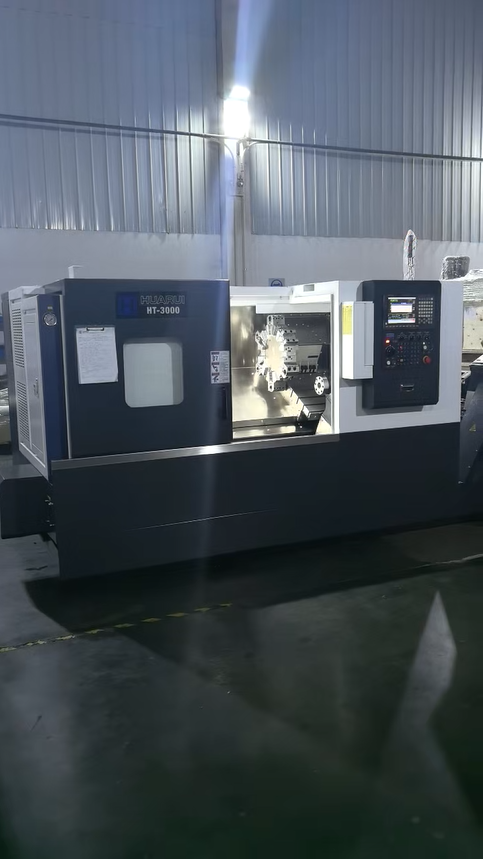
Walking the floor of a busy shop, you’ll hear seasoned machinists say the best turning machine isn’t always the one with the highest spindle speed or the latest control. It’s the one that quietly aligns with how your team actually works—the rhythms of setup, the typical batch sizes, the materials that show up day after day. A machine that fights your workflow, no matter how capable on paper, will slowly bleed time and morale. The real art is seeing past the glossy spec sheets and into the daily dance between operator, part, and chip.
This choice gets particularly tricky when you’re balancing precision with practicality. A shop chasing tenths on exotic alloys needs a different animal than one hogging out mild steel by the pound. Rigidity, thermal stability, and damping characteristics become make-or-break factors that rarely headline a brochure. Sometimes the right move isn’t a new machine at all, but a well-maintained used one that has already proven its mettle in a similar environment. The subtlety lies in matching the machine’s character to the work’s demands—not overbuying on features that will never see a chip, or underbuying on the foundation that holds every cut true.
Beyond the iron and electronics, there’s the human element that no configurator captures. How quickly can your crew learn its quirks? Will maintenance support be a phone call away, or a logistical headache? The best machine in the world becomes a paperweight if it sits idle waiting for a technician while a simpler, more supportable lathe could be making parts two towns over. Smart shops look at the machine, the vendor, the application, and the team as an ecosystem. When that system breathes together, the choice stops being a gamble and starts feeling inevitable.
Hidden Features That Make a Difference in Precision Manufacturing
Beyond the gleaming exteriors and micron-level tolerances lies a world of subtle engineering choices that quietly elevate output quality. One often-overlooked aspect is the interplay between thermal stability and material selection in machine tool frames. Instead of simply relying on empirical data, leading shops now integrate low-expansion alloys and strategically placed cooling channels that counteract heat-induced drift during long cycles. This isn’t about flashy upgrades — it’s a deliberate, physics-aware approach that keeps dimensions stable hours into a run, turning an ordinary machining center into a reliable workhorse without fanfare.
Another silent game-changer is the sophistication hiding in servo tuning algorithms. Off-the-shelf drives follow standard curves, but tailoring acceleration ramps and jerk limits to the specific mass and resonance of each axis transforms surface finish and tool life. When a machine’s motion profile is fine-tuned to avoid micro-hesitations at quadrant transitions, the result is near-perfect interpolation on complex contours. The difference isn’t theoretical — it shows up as mirror-like finishes on dies and molds, achieved not through polishing tricks but through the geometry of motion itself.
Then there’s the quiet revolution in real-time process adaptation. Rather than merely reacting to tool wear with predefined offsets, advanced systems monitor spindle load harmonics and acoustic signals to distinguish between normal chatter and early edge degradation. This lets them nudge feeds and cutting depths preemptively, maintaining part consistency until the very last cut. It’s a learning loop that operates beneath the interface, where the machine almost develops a sense of when a tool is about to fail, squeezing out extra value from every insert without ever sounding an alarm.
Real-World Applications: Where Precision Turning Shines Brightest
From surgical tools that navigate the human body with microscopic accuracy to the fuel injectors feeding next-gen jet engines, precision turning quietly enables components that can’t afford even a whisper of error. In medical manufacturing, it shapes bone screws and implantable devices with surface finishes smooth enough to coexist with living tissue, while aerospace relies on turned parts that hold tight tolerances under extreme thermal swings and vibrations.
Over in automotive, the technique is indispensable for prototyping high-performance drivetrain components—lightweight, concentric shafts and valve bodies that translate directly into better throttle response and efficiency. Electronics manufacturing also leans heavily on Swiss-style turning to produce the miniature pins, connectors, and sensor housings crammed into ever-shrinking consumer devices.
Even the energy sector showcases its muscle: precision-turned rotors and impellers help pumps maintain consistent flow rates in harsh oilfield environments or in the turbines that push renewable power onto the grid. It’s in these demanding settings—where repeatability meets material challenges like titanium, Inconel, or engineered plastics—that the process really separates itself from conventional machining.
Avoiding the Pitfalls: Common Mistakes When Investing in a Turning Machine
One of the most frequent blunders is focusing solely on the sticker price. A low upfront cost often masks hidden expenses like shorter tool life, higher energy consumption, and frequent breakdowns. Savvy buyers look at the total cost of ownership, including maintenance, tooling, and expected uptime. Another trap is overestimating needed capabilities. Purchasing a machine with features you'll rarely use not only wastes capital but also complicates training and maintenance. Instead, map your production requirements carefully and match the machine's specifications to your actual workload.
Undervaluing operator training is a silent killer of profitability. Even the finest turning machine will underperform if the team doesn’t know how to leverage its full potential. Allocate time and budget for comprehensive training from day one, and consider periodic refreshers as new techniques emerge. Additionally, neglecting to investigate the availability and cost of replacement parts can lead to painful downtime. Prior to purchase, verify local supplier support networks and typical lead times for critical components. Finally, many buyers overlook the impact of workholding and tooling compatibility, which can severely limit a machine’s versatility. A little upfront research here prevents a great deal of frustration later.
The Future of Precision Turning: Innovations to Watch
Precision turning is shedding its old skin, driven by a wave of quiet but transformative shifts that go far beyond faster spindles or tighter tolerances. One of the most profound changes is the embedding of real-time process control directly into the turning cell. Instead of relying on post-process inspection, modern lathes now use high-frequency vibration sensors, force dynamometers, and even in-process laser measurement to adjust tool paths on the fly. This closed-loop approach slashes scrap rates and enables unattended machining of complex geometries in exotics like Inconel or titanium. The real innovation isn’t just the hardware—it’s the algorithms that model chip formation and predict tool wear before it causes a single defect, effectively turning the lathe into a self-correcting production system.
Material science is redrawing the boundaries of what turning can achieve. Hybrid cutting tools with graded carbide substrates and nano-structured coatings, such as titanium-aluminum-nitride layers engineered atom by atom, are now tailored to specific workpiece alloys. These tools exhibit a remarkable ability to dissipate heat and resist microchipping, allowing dry machining at speeds that would have destroyed conventional inserts. Simultaneously, workpiece materials themselves are evolving: metal matrix composites and additively manufactured pre-forms are moving from the lab to the shop floor. Precision turning must adapt to these inhomogeneous, often abrasive structures, spurring the development of adaptive strategies that vary cut depth and feed in microseconds to maintain surface integrity. It’s a duet between tool and material that feels almost organic.
Beyond the machine envelope, the future of precision turning is being shaped by new data architectures that connect shop-floor operations to broader manufacturing intelligence. Edge computing modules mounted directly on lathes process terabytes of sensor data in real time, distilling it into actionable insights without cloud latency. This distributed intelligence fuels digital twins that simulate thousands of turning scenarios overnight, optimizing every parameter from tool path to coolant nozzle angle before a single chip is cut. Smaller manufacturers, in particular, are leveraging this modular tech to leapfrog traditional scaling hurdles, achieving process repeatability that once belonged only to high-volume automotive lines. The result is a democratization of precision: turning systems that learn, share information across fleets, and continuously evolve, making high-mix, low-volume runs economically viable without sacrificing quality.
FAQ
Precision turning machines are advanced lathes designed to achieve exceptionally tight tolerances and surface finishes, often within microns. Unlike standard lathes, they incorporate high-rigidity structures, linear motors, hydrostatic bearings, and sophisticated thermal compensation systems to minimize vibration, thermal growth, and positional error. This allows them to produce complex geometries with repeatable accuracy, making them essential for industries like aerospace, medical devices, and optics.
While there are many great options, a few names consistently lead in ultra-precision: Hardinge for their Super-Precision models, DMG MORI with the NLX series, and Tsugami for Swiss-type turning. For true nano-level work, Moore Nanotechnology and Precitech dominate. Kern and Makino also offer exceptional turn-mill centers. The 'best' really depends on whether you need sub-micron form accuracy or high-volume Cpk-driven production.
First, look at the base construction—polymer granite or heavily ribbed cast iron for vibration dampening. The spindle is critical: hydrostatic or high-precision rolling element bearings with active cooling. Linear glass scales with 0.1 µm resolution are a must for positioning. Don't overlook thermal management; look for active temperature control of coolant, ball screws, and even the machine frame. Also, the control system and its ability to do in-process measurement and compensation is vital.
In medical bone screw production, a manufacturer switched from a standard Swiss-type to a Tsugami S206 with an automatic guide bushing adjustment. They virtually eliminated scrap from barstock diameter variance, and surface finish improved from Ra 0.4 to Ra 0.1, which reduced osteoblast adhesion issues. That machine's ability to maintain thermal stability over 24/7 cycling was the game-changer—part variation dropped by 60% across a million-part run.
Don't just compare price tags. Calculate the true cost of quality: if you're spending hours hand-polishing parts to meet spec, or experiencing field failures from inconsistent fits, the ultra-precision lathe pays for itself rapidly. It often eliminates secondary grinding or lapping operations, reduces scrap, and opens doors to higher-margin work. One optics company found that a single Precitech lathe replaced three conventional machines and two polishing stations, with a ROI under 14 months.
It's a bigger factor than most people realize. Modern CNCs like the Fanuc 31i-B5 or Siemens 840D sl offer features like chatter suppression, adaptive feedrate control, and real-time volumetric compensation. Some machines use digital twin simulation to optimize toolpaths before cutting. More importantly, the integration of on-machine probing and laser tool setters with automatic offset updates ensures the process stays in control without operator intervention, which is essential for unmanned precision manufacturing.
Conclusion
Precision turning machines are the backbone of modern manufacturing, but not all lathes are created equal. What truly sets a high-precision lathe apart is its ability to maintain tight tolerances under varying conditions—rigidity, thermal stability, and spindle accuracy are non-negotiable. When choosing a machine for your shop, it’s not just about brand names or specs on paper; it’s about how the machine performs with your specific materials and workflows. Many machinists overlook the subtle art of matching machine capabilities to real production demands, often focusing too much on maximum RPM or horsepower while ignoring details like vibration damping or coolant delivery. Hidden features, such as hydrostatic guideways or integrated tool setters, can dramatically improve surface finish and reduce downtime, yet they rarely make the brochure. These understated elements often separate a reliable workhorse from a constant headache.
In practice, precision turning shines brightest in industries like aerospace, medical device manufacturing, and automotive prototyping, where a micron-level error can compromise safety or functionality. Shops that invest wisely see faster cycle times, less scrap, and the ability to take on more complex parts. However, it’s easy to fall into traps—overbuying unnecessary features or underestimating maintenance costs are common pitfalls that can erode ROI. As technology advances, innovations like sensor-driven process monitoring, AI-assisted optimization, and hybrid additive-subtractive machines are reshaping what’s possible. The top 10 picks in this guide are not simply a list; they represent a cross-section of machines that excel in real-world conditions, chosen for their proven performance, adaptability, and forward-thinking design. Ultimately, selecting the right turning machine is a blend of engineering insight and practical experience, and staying ahead means understanding both the fundamentals and the emerging trends.
Contact Us
Contact Person: Tim
Email: [email protected]
Tel/WhatsApp: +86 15522553731
Website: https://www.winnrui-cnc.com/