

Pharmaceutical Excipient Silica: Which Type Is the Strongest?
2026-08-28
Ever wondered why some tablets hold together better than others? The answer often lies in a tiny ingredient: silica. As a pharmaceutical excipient, silica isn’t just a filler—it can be the backbone of your formulation’s strength. But with multiple types on the market, which one actually delivers the most mechanical muscle? Let’s look at the real differences, and see where Zhonglian fits into the picture.
What 'Strong' Actually Means for Excipients
When formulators call an excipient "strong," they rarely mean it has high mechanical hardness or chemical reactivity. In the excipient world, strength is about predictability under stress: how consistently a filler, binder, or disintegrant behaves when compression forces shift, humidity spikes, or a new API changes the blend's rheology. A strong excipient is one you don't have to babysit.
That reliability shows up in batch records that don't drift, tablet hardness that stays within spec without constant adjustment, and dissolution profiles that remain stable after six months on a shelf. It's not a single measurable property but a pattern of low variability and wide processing latitude. Many materials perform fine in ideal conditions; few keep performing when the mixer runs hot or the granulation endpoint moves by a few minutes. In practical terms, a strong excipient often means fewer reformulations, less time troubleshooting on the floor, and a supply chain that doesn't surprise you with a different particle size distribution every quarter.
The Fumed Silica Edge
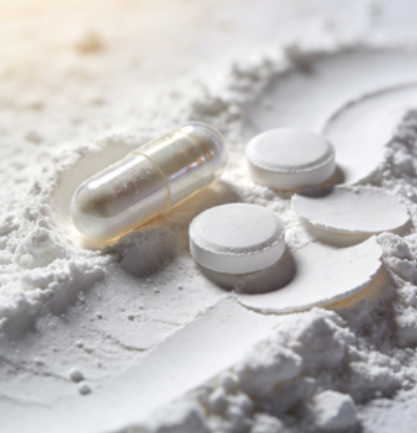
Fumed silica earns its reputation through a combination of nanoscale particle size and exceptionally high surface area. Unlike conventional fillers, its chain-like aggregated structure creates a three-dimensional network even at low loadings, which dramatically alters rheology. This network can be disrupted under shear and rebuilds when shear is removed, giving formulators precise control over viscosity, thixotropy, and anti-settling behavior in liquids, pastes, and gels.
In adhesives and sealants, the edge becomes tangible as improved slump resistance and gap filling without sacrificing extrusion ease. In coatings, it prevents pigment settling and sag on vertical surfaces during curing. For silicone elastomers and composites, fumed silica delivers a notable boost in tear strength and tensile modulus while keeping the base polymer's elongation relatively intact—a balance that precipitated silica struggles to match at equivalent loading levels.
The real differentiator, however, lies in consistency and customization. By adjusting the silanol group density and hydrophobic treatment, manufacturers can tailor the surface chemistry to polar or non-polar systems, enabling reliable performance across epoxies, polyurethanes, and silicones. This tunability, paired with reproducible aggregate morphology from flame hydrolysis, gives engineers a predictable tool for solving formulation challenges without trial-and-error guesswork.
Precipitated Powder Under Pressure
Precipitated powders often arrive as loose agglomerates of fine primary particles. When a die applies pressure, the first thing that happens is not particle deformation but wholesale rearrangement. The agglomerates crush against one another, filling large voids almost immediately. Because the individual crystallites are small and irregular, they pack into a surprisingly dense network well before any significant plastic flow begins.
As the load climbs, the remaining porosity shrinks through a mix of particle sliding and local fracture at contact points. Some precipitated materials, especially those with layered or needle-like habits, show a pronounced tendency to align under uniaxial pressure. This can produce anisotropic green bodies with better mechanical integrity in one direction. Small amounts of residual moisture or adsorbed species on the powder surface sometimes act as a lubricant, lowering interparticle friction and allowing closer approach of grains.
Near the end of the pressing cycle, the compact enters a stage where further densification demands actual deformation of the primary particles. Here the yield strength of the material sets a practical limit. For many precipitated oxides and carbonates, this limit arrives before full density is reached, leaving a fine network of intergranular pores. Subsequent sintering can close much of that porosity, but the pressing step fixes the overall uniformity. That is why powder preparation and pressing pressure must be tuned together rather than treated as separate variables.
Hydrophobic Coatings Make a Difference
The first time you watch water glide off a treated surface, it feels like watching a magic trick. Raindrops bead up and roll away, carrying dirt and grime with them, leaving the surface cleaner than it was before. That's the quiet power of hydrophobic coatings—they don't just repel water; they change how a material behaves in everyday conditions. Instead of absorbing moisture, the treated surface forces water to form tight spheres that barely touch the underlying layer. This simple shift reduces staining, slows corrosion, and makes routine cleaning far less of a chore.
What makes these coatings work is a combination of surface chemistry and microscopic texture. At the molecular level, the coating lowers the surface energy so water molecules prefer to cling to each other rather than spread out. At the same time, nano-scale roughness traps tiny pockets of air beneath each droplet, creating a cushion that lets the water roll off with almost no friction. This dual effect is what separates a true hydrophobic treatment from a basic wax or sealant—the coating doesn't just slow water absorption, it actively prevents the water from making contact in the first place.
In real-world use, the difference shows up in ways you might not expect. A car windshield treated with a hydrophobic layer stays clearer in heavy rain, because water beads fly off at highway speeds instead of smearing across the glass. Shower doors resist soap scum buildup, and outdoor fabric dries in minutes rather than hours. Even concrete and stone benefit, as hydrophobic treatments block the freeze-thaw damage that occurs when water seeps into pores and expands. The results aren't dramatic in the moment—no loud noise or visible transformation—but over weeks and months, the coating quietly extends the life of the material and cuts down on maintenance time.
Porosity: The Quiet Strength Multiplier
Porosity rarely gets the credit it deserves. In materials, we usually chase density, hardness, or smoothness—yet it's the deliberate absence of material that often unlocks surprising resilience. Think of bone tissue: its spongy interior isn't a flaw but a masterstroke of load distribution, making the whole structure lighter without sacrificing toughness.
This quiet multiplier works because voids aren't simply empty. They create pathways for stress relief, for fluid movement, for energy dissipation. A porous ceramic filter, for instance, withstands thermal shock better than its solid counterpart—not despite the holes, but because of them. The strength doesn't come from filling every gap; it comes from knowing which gaps to leave open.
When we stop treating porosity as a weakness to be eliminated and start seeing it as a design variable, the math changes. Add the right amount of nothing, and you get something stronger, more adaptive, and often more alive. That's the hidden leverage of the void.
Choosing Based on Dose Form, Not Hype
Selecting a medicine based on how it’s made rather than how it’s marketed sounds obvious, yet many people still reach for a “new” spray or strip without asking whether that form actually fits their schedule. A well-made tablet that you can swallow with water and forget about often does more than a fancy orally disintegrating version that crumbles in the bottle or leaves a chalky residue.
Consider the practical details: do you need to split doses, carry the medicine in a bag, or avoid a particular texture? If you struggle with pills, a scored tablet you can halve may be more useful than a coated capsule that can’t be split. If you’re managing pain at night, a patch or an extended-release capsule might keep you asleep longer than a fast-acting liquid that wears off in four hours.
Drug makers sometimes lean on novel delivery formats to refresh an older product, but a different dose form rarely changes the fundamental drug. What changes is how reliably you’ll take it. Pick the form that matches your daily habits and physical comfort, not the one with the most attention-grabbing commercial. That’s where the real benefit shows up.
FAQ
Fumed silica carries a much higher surface area and a branched, chain-like aggregate structure, which gives it stronger thickening and anti-caking effects. Precipitated silica, by contrast, has a more rounded particle shape and lower surface area, so it provides gentler flow improvement without the same degree of viscosity build.
Its extremely small primary particle size and high surface silanol density allow it to coat larger excipient particles and reduce interparticle friction. That coating action creates a smoother, more predictable powder flow, which is why it outperforms many other silicas as a glidant.
Fumed silica generally offers the greatest mechanical reinforcement because its fractal aggregates can form a three-dimensional network inside a matrix. This network resists deformation and can improve tablet hardness or film strength more effectively than precipitated or gel forms.
Rarely at the same time. A highly porous silica gel is an excellent moisture scavenger but often has poor flow properties and can cake. Fumed or colloidal silicas are better flow aids but have lower bulk water capacity. Formulators usually split these functions between grades.
Smaller primary particles and higher surface area increase the number of contact points and silanol groups available for hydrogen bonding. This raises the cohesive energy between particles and the surrounding matrix. However, beyond a certain surface area, dispersion becomes difficult and the reinforcement benefit plateaus or even drops.
Not necessarily. A very high surface area fumed silica can create excessive viscosity, reduce bulk density too much, or make a blend overly cohesive. The best choice balances the required flow, moisture protection, compaction, and manufacturability, rather than simply picking the grade with the highest surface area or aggregate strength.
Silanol groups form hydrogen bonds with water, polymers, and other excipients. A higher density of accessible silanols means more potential bonding sites, which increases adhesion and reinforcement. But if silanols are buried inside pores or blocked by surface treatments, the measured surface area alone will not predict the actual binding strength.
Because different silica types solve different problems. A blend can combine the strong anti-caking action of fumed silica with the moisture buffering of a porous silica gel, or balance the high surface area of one grade with the better compaction behavior of another. This tailored approach avoids the downsides of any single extreme grade.
Conclusion
Strength in an excipient is not one property. For silica, it could mean surviving tablet compression without turning to dust, preventing a powder blend from seizing up in humidity, or keeping flow smooth at remarkably low use levels. Fumed silica usually dominates the last two. Its fused, branching aggregates spread through a blend like a dry scaffold, giving high surface area and low bulk density that stop moisture bridging and caking with barely any weight added. Precipitated silica is less elegant in that role, but under direct compression its heavier, rounder particles often resist fracture better, so a tablet formulator may call it stronger while a powder formulator would not.
Coatings change the ranking. Untreated hydrophilic silica can quietly absorb water and lose its glidant effect, while a hydrophobic coating preserves dry-state performance. A hydrophobic grade sheds moisture instead of soaking it up, which matters more than raw surface area in tropical packaging or effervescent blends. Porosity also cuts both ways: more pores mean better oil and water uptake, but they create weak points that crush under high shear. The strongest silica ends up being the one matched to the stress your process actually applies. A dry powder inhaler, a chewable tablet, and a humidity-sensitive capsule fill each punish the excipient differently, and chasing a single 'strongest' type ignores that reality.
Contact Us
Contact Person: Levin Wang
Email: [email protected]
Tel/WhatsApp: 8618668999988
Website: https://www.silicaplant.com/