

High Volume Low Speed Fans in China: Benefits and Applications
2026-06-26
In the sweltering heat of China—where massive factories, warehouses, and gymnasiums stretch for acres—traditional fans simply can’t cut it. But industrial engineers have quietly embraced a giant solution: High Volume Low Speed (HVLS) fans. Unlike their buzzing desktop cousins, these giants gently move enormous air columns, slicing energy costs while keeping workers cool and productive. As a leading name in this niche, VINDUSFAN has been reshaping large-space ventilation with designs that marry efficiency and whisper-quiet operation. Yet, many facility managers still wonder: are HVLS fans truly worth the investment in China’s diverse climates? This blog unpacks the real-world benefits, from reducing humidity in Guangzhou to easing heat stress in Chongqing, and reveals why the right fan choice can transform operational budgets.
Transforming Industrial Comfort with HVLS Fans
Large industrial spaces have always wrestled with maintaining consistent temperatures and air quality, often relying on a patchwork of smaller fans or costly HVAC upgrades. The introduction of high-volume, low-speed fans has quietly reshaped that landscape, offering a surprisingly simple way to keep workers comfortable without the deafening roar or energy drain of traditional methods.
These fans move massive columns of air slowly and steadily, creating a gentle breeze that reaches every corner of a warehouse, factory, or hangar. In the summer, the airflow makes people feel up to 10°F (5°C) cooler, while in winter, they push warm air trapped near the ceiling back down to the floor, slashing heating costs. It’s a year-round fix that doesn’t just lower energy bills—it reduces stuffiness and airborne moisture, which means fewer rusted equipment and a healthier indoor environment.
Beyond the numbers on a thermostat, the real transformation shows up on the shop floor. Employees are less fatigued, more focused, and productivity climbs when they’re not distracted by heat or cold spots. Facility managers discover that a handful of strategically placed HVLS fans can replace dozens of noisy pedestal units, freeing up floor space and cutting maintenance headaches. The result is a workplace where comfort isn’t an afterthought but a seamless part of how the building breathes.
Energy Efficiency Meets Large-Space Cooling
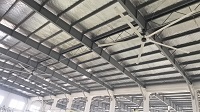
Cooling vast spaces like warehouses, stadiums, and airports has long been an energy-intensive headache. Traditional systems often blast cold air with little precision, wasting power as they fight against high ceilings and constant openings. But a new wave of efficiency-focused design is changing the game, proving that large-scale cooling doesn’t have to come with oversized energy bills.
The secret lies in blending smart technology with physics. Advanced evaporative cooling, radiant slab systems, and high-volume low-speed (HVLS) fans now work in concert, distributing air evenly while consuming a fraction of the energy. Sensors and predictive controls adjust output in real time, targeting occupied zones rather than conditioning every cubic foot. This shift from brute force to intelligent management can slash consumption by half or more.
Beyond equipment, the approach embraces building design itself—using natural ventilation, thermal mass, and reflective roofing to reduce heat loads before mechanical systems ever kick in. The result is a quieter, more comfortable, and surprisingly sustainable solution for mammoth interiors. As energy costs rise and climate goals tighten, marrying efficiency with large-space cooling isn’t just smart; it’s becoming a necessity.
Key Applications in Chinese Manufacturing
Across China's vast factory floors, industrial robots now weld car frames, polish smartphone casings, and pack electronics with a consistency that's hard to match manually. Their adoption has spread well beyond the automotive sector, with thousands of collaborative arms handling delicate assembly tasks in spaces once reserved for human workers.
Quality checks, once a bottleneck, now lean heavily on machine vision systems that scan for microscopic defects in real time. From inspecting printed circuit boards to verifying textile patterns, these systems have quietly become the norm in export-oriented production lines, where a single missed flaw can cascade into costly returns.
Behind the scenes, factory management software has tied shop-floor sensors directly to inventory and shipping, letting production planners shift schedules in hours rather than days. This tighter link between making and moving goods is especially visible in the consumer electronics and home appliance sectors, where demand swings with brutal speed.
Enhancing Worker Productivity and Safety
When safety protocols are woven into daily routines, they stop being checkboxes and start becoming habits that directly reduce downtime. Fewer incidents mean fewer interruptions, letting teams maintain a steady rhythm without the costly pauses of accident investigations or equipment repairs. Workers who trust their environment also tend to engage more deeply, often spotting inefficiencies that outsiders miss.
Practical adjustments often yield surprising gains. Simple ergonomic tweaks—like repositioning tools to waist height—cut repetitive strain and shave seconds off tasks. Equipping floor supervisors with real-time fatigue monitors has proven particularly effective in high-risk settings, flagging early signs of exhaustion before they cascade into mistakes. Pairing such tech with brief pre-shift huddles keeps awareness high without bogging people down in lengthy meetings.
Sustainable progress comes from listening to those doing the work. When frontline insights drive iterative changes—whether redesigning a workstation or reordering a process—adoption is faster and results stick. Leadership’s role is to remove obstacles and visibly support these efforts, turning productivity and safety into two sides of the same coin rather than competing priorities.
Modernizing Warehouses and Logistics Centers
Warehouses and logistics centers are no longer just storage depots—they’ve become dynamic hubs where speed meets precision. The push to modernize is driven by exploding e-commerce demands and the need to shrink delivery times. Companies are rethinking layouts, adopting smarter software, and integrating real-time tracking so every item moves with purpose. It’s a shift that turns static spaces into agile operations, ready to handle spikes without missing a beat.
Automation sits at the heart of this transformation. From autonomous mobile robots whirring through aisles to automated sorting systems that route packages in seconds, machines now handle the repetitive grind. Meanwhile, warehouse management platforms crunch data to optimize inventory placement and predict restocking needs. These tools don’t just speed things up—they slash errors and let human workers focus on oversight, problem-solving, and customer service rather than endless walking and counting.
Sustainability and adaptability are rewriting the blueprint as well. Energy-efficient lighting, solar panels, and smart HVAC systems lower operating costs while meeting greener standards. Modular designs allow facilities to reconfigure quickly as product lines change. These spaces are evolving into flexible ecosystems where technology and foresight keep supply chains humming, even when the unexpected hits.
The Quiet Rise of HVLS Technology in China
Not long ago, large industrial fans in Chinese factories were imported novelties, their size and efficiency often viewed as an indulgence rather than a necessity. Today, the story is entirely different. High Volume Low Speed (HVLS) technology has slipped into the country's commercial and industrial landscape with little fanfare, yet its impact is unmistakable. From vast logistics centers in the Pearl River Delta to livestock barns in the northern plains, these quietly spinning giants are reshaping microclimates and energy consumption patterns. The shift didn’t come through aggressive marketing campaigns but through word-of-mouth among facility managers who noticed lower cooling costs and year-round comfort improvements. In a nation where energy efficiency has become both an economic and regulatory priority, HVLS fans became the unobtrusive solution nobody was talking about—but everybody was installing.
The domestic manufacturing surge caught even industry insiders by surprise. A decade ago, Chinese firms were merely assembling components for foreign brands; now, local giants lead not only in production volume but in blade design innovations tailored to humid, mixed-use spaces typical of Asian infrastructure. Companies ditched the one-size-fits-all approach, developing lightweight composite materials that withstand monsoon moisture and integrating smart sensors that adjust fan speeds based on real-time temperature and occupancy data. These aren’t copycat products. They’re engineered from the ground up for the rhythmic chaos of Chinese workshops, where forklifts and makeshift offices coexist under one roof. The result is a technology that feels less like an imported luxury and more like a natural extension of the local architecture—so much so that new constructions increasingly include HVLS systems from blueprint stage, not as an afterthought.
What’s fascinating is how HVLS adoption is redrawing the map of comfort engineering. Traditional air conditioning struggles in open, high-bay structures, but these fans create gentle, vertical temperature equalization that can reduce reliance on HVAC by 30% or more—a statistic that quietly resonates with cost-conscious owners. Beyond numbers, there’s a human element. Workers under previously stagnant domes now describe a faint, natural breeze that lifts morale without the roar of high-speed alternatives. As China’s push for carbon neutrality intensifies, the technology’s low power draw and maintenance simplicity have turned it from a niche option into a standard specification, all while staying under the radar of mainstream headlines. The quiet rise of HVLS here isn’t just about fans; it’s about a pragmatic, almost invisible transformation in how large spaces are ventilated, cooled, and experienced.
FAQ
High volume low speed (HVLS) fans are large ceiling-mounted fans with blades that can span up to 24 feet. Unlike typical high-speed industrial fans that blast air in a narrow stream, HVLS fans move a massive column of air slowly and gently. The key difference is in coverage and efficiency: one HVLS fan can effectively ventilate an area of roughly 20,000 square feet, while you'd need dozens of smaller fans to achieve similar air movement. The slow speed also makes them much quieter and more comfortable for people working below.
In large open areas with high ceilings, temperature stratification is a common problem—hot air rises and gets trapped near the roof while the lower levels stay chilly in winter or oppressively hot in summer. HVLS fans gently push that warm air back down to floor level, equalizing temperatures from ceiling to floor. This can reduce heating costs by 20–30% in winter. In summer, the persistent breeze creates a wind-chill effect that makes workers feel up to 10°F cooler, lowering the perceived temperature without air conditioning. The fans also help reduce condensation and keep concrete floors dry, improving safety.
By destratifying the air, HVLS fans reduce the load on HVAC systems. In cold months, they recirculate heat that would otherwise be wasted near the ceiling, so the thermostat can be set lower without sacrificing comfort. In warm months, they allow facility managers to raise the set point of air conditioning by several degrees while maintaining the same level of occupant comfort, or sometimes eliminate the need for AC entirely. Because the fans themselves consume relatively little electricity (usually between 0.15 and 1.5 kW), the energy payback can be quite fast—often within a year or two in round-the-clock operations.
You'll find HVLS fans in many settings across China. Large manufacturing plants, especially in automotive and electronics, use them to keep work zones comfortable and within temperature tolerances. In logistics, sprawling distribution centers and cross-dock facilities depend on them for air circulation. Public venues like airport terminals, high-speed rail stations, and indoor sports stadiums also install HVLS fans to manage air quality and comfort for large crowds. They're increasingly popular in agricultural operations—dairy barns, poultry houses—to reduce heat stress in livestock. Even some large retail spaces, like furniture stores or warehouse clubs, have started adopting them to improve the shopping experience while cutting energy bills.
Yes, structural integrity is the first thing to check. Many older buildings weren't designed to support the weight or dynamic forces of a large rotating fan. Engineers usually need to assess the roof truss or beam load capacity and may require additional reinforcement. Vibration isolation is also critical to prevent noise and structural fatigue, especially in buildings with metal roofs. Electrical retrofits might be necessary because HVLS fans often use variable frequency drives that need stable power. Local regulations in some provinces have specific seismic and wind load requirements, so it's wise to involve a local structural engineer early on. Ceiling height matters too—fans need at least 6 to 10 feet of clearance from the nearest obstruction.
Dusty conditions, common in textile mills or cement plants, can quickly coat the blades, reducing airflow and unbalancing the fan. Routine cleaning of the blades and motor housing is essential—usually a soft brush or compressed air does the trick. Bearings in larger fans may be sealed for life, but some models need periodic greasing. It's also important to check all mounting bolts and safety cables for tightness and corrosion every few months. The variable frequency drive should be inspected for proper ventilation and cleaned of dust buildup. In really harsh environments, adding air filters to the electrical enclosures and choosing fans with corrosion-resistant coatings can prevent long-term damage.
Yes, they can be installed in covered outdoor areas as long as the fan is rated for damp or wet conditions. Many manufacturers offer IP-rated motors and corrosion-resistant finishes for such applications. In semi-open restaurants, hotel lobbies with open atriums, or covered parking decks, HVLS fans provide a gentle breeze that keeps the area feeling fresh even on humid days. However, for fully exposed outdoor use where the fan might be hit by rain or snow, you need to look for purpose-built models with sealed motors and rust-proof hardware. It's also important to consider wind loads—in typhoon-prone regions, outdoor fans must be able to withstand high gusts or have automatic retraction mechanisms.
Conclusion
Across China’s vast industrial landscape, high-volume low-speed (HVLS) fans are quietly reshaping how factories and warehouses manage climate control. Unlike traditional high-speed fans that blast air erratically, these oversized ceiling fans move massive columns of air gently and uniformly, creating a pervasive cooling effect that transforms stifling work environments. The technology’s adoption has been subtle yet relentless, driven by a fusion of energy efficiency and practical large-space cooling needs. By slowly circulating air from floor to ceiling, HVLS units dramatically reduce reliance on air conditioning, cutting electricity consumption by up to 30% in many cases. This not only slashes operational costs but also aligns with China's broader push toward sustainable industrial practices.
The real-world impact is most tangible in China’s manufacturing powerhouses, where soaring summer temperatures once sapped worker endurance. HVLS installations in electronics plants, textile mills, and automotive assembly lines have proven critical in stabilizing indoor climates, directly boosting productivity and minimizing heat-related safety risks. Beyond factories, logistics centers and massive storage depots are adopting these fans to combat stagnant air that can degrade goods and create unsafe dust buildup. A single HVLS unit can replace dozens of floor fans, clearing aisles of trip hazards and maintaining consistent conditions across enormous footprints. As awareness spreads, the quiet hum of these fans is becoming a symbol of smarter, safer, and more cost-conscious operations across the country.
Contact Us
Contact Person: Michael Danielsson
Email: [email protected]
Tel/WhatsApp: +1 951 565 7769
Website: https://www.vindusfans.com