

High-Strength Steel Soil Foundation Formwork: Quality You Can Rely On
2026-09-29
Most foundation failures aren't caused by bad concrete—they're caused by formwork that flexes, leaks, or gives way under pressure. That's where high-strength steel soil foundation formwork earns its keep. LugongMachinery designs these systems to hold tolerances, resist ground movement, and deliver the kind of quality you can rely on from first pour to final cure. Before you trust your next slab to anything less, here's what actually separates dependable steel formwork from the rest.
How High-Strength Steel Holds Up Under Wet, Unstable Soils
High-strength steel earns its reputation in wet, unstable soils by resisting both corrosion and deformation under shifting loads. Unlike conventional grades, its refined grain structure and controlled alloying allow it to maintain yield strength even when moisture saturates the surrounding ground. This matters because waterlogged soils exert uneven lateral pressures, and a weaker material would gradually bow or crack. The steel's toughness prevents micro-tearing at stress points, so foundations and retaining systems stay intact through freeze-thaw cycles and sudden pore-water pressure spikes.
In practice, engineers rely on this behavior for driven piles and anchored walls placed in soft clays or loose sands. The high-strength composition accepts higher driving stresses without buckling, which simplifies installation in ground that shifts under vibration. After placement, the steel's resistance to hydrogen embrittlement—a common failure mode in acidic, waterlogged soils—ensures long-term ductility. Field measurements from coastal and riverine projects consistently show less section loss and fewer repairs compared to standard carbon steel, even after decades of exposure to fluctuating water tables.
Another advantage is the material's compatibility with modern coatings and cathodic protection. Because high-strength steel forms a stable oxide layer under cyclic wetting, it bonds more reliably with epoxy or zinc-based barriers. In unstable slopes, where soil creep exerts continuous low-level strain, the steel's high modulus limits deflection enough to keep drainage paths open. This reduces pore pressure buildup behind retaining structures, breaking the feedback loop that often leads to sudden bearing failure. The result is a foundation system that performs predictably without overdesign, even when the ground beneath it never truly rests.
Panel Design That Keeps Concrete Lines Clean and True
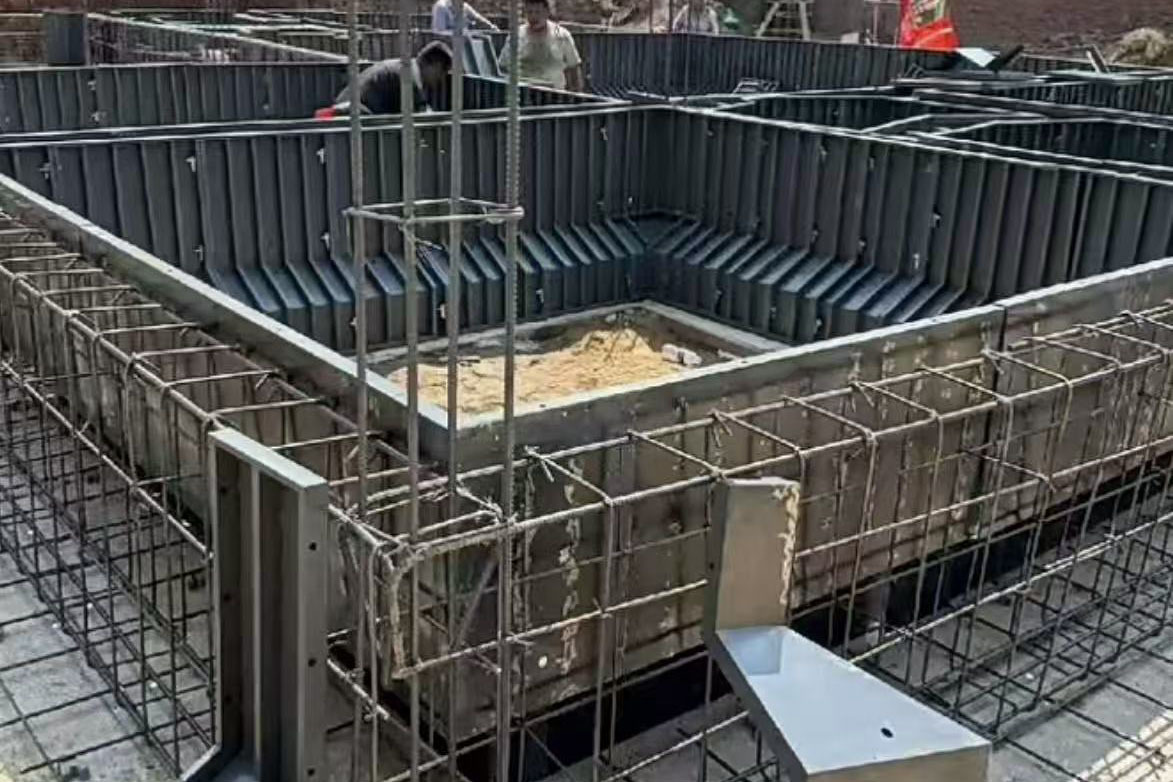
Clean concrete lines start well before the pour. Panel joints are not afterthoughts; they are drawn, dimensioned, and coordinated with structural openings, corner returns, and changes in plane. In practice, this means aligning vertical and horizontal reveals with door heads, window sills, and slab edges so the formwork pattern reads as intentional rather than accidental. A tapered or chamfered strip at the joint helps the eye accept small irregularities in the surface, while a sharp square edge demands a level of precision that most site-built forms cannot reliably deliver.
The choice of panel material also shapes the final line. Plywood with a medium-density overlay gives a smoother finish and fewer grain transfers than standard forming panels, but it still flexes under the weight of fresh concrete. Where panels meet, a continuous backing member and tight, evenly spaced clamps keep the joint from opening mid-pour. For corners, a single fabricated form or a locked external corner tie is more likely to hold the line than two panels butted together and braced independently.
After stripping, the work is not finished. Small misalignments, grout loss, and tie-hole patching can blur an otherwise sharp line. A light rub with a carborundum stone or a slurry of cement and fine sand can bring adjacent panels into the same plane without erasing the texture. The goal is not a perfectly flat surface but a consistent one, where the eye follows the intended breaks instead of the accidental ones.
Assembly Sequence That Cuts Foundation Prep Time
Most crews waste hours wrestling with form boards, leveling gravel, and rechecking layout lines. A smarter assembly order flips that routine: set your anchor bolts and bracket templates first, then drop the pre-cut sill plates onto them. This lets you lock the foundation outline in one motion instead of shimming and nudging for half the morning.
The real time-saver is sequencing the forms as modular frames rather than building them stick by stick in the trench. Preassemble two long sides and one end wall on flat ground, square them with a tape and diagonal brace, then walk the whole unit into place. You can fine-tune the remaining corner with a single wedge instead of resetting an entire wall run.
Finally, move the grade work to after the forms are set, not before. Rough-level the pad only enough to keep the frames plumb, then pour in your compactable base through the open top. One pass with a vibratory plate settles everything against the inside face of the form, so you skip the usual backfill and hand-tamp routine altogether.
What Reuse Looks Like After 200 Pour Cycles
After 200 pour cycles, the surface carries a faint, even wear line around the rim where liquid has broken over it hundreds of times. The handle's grip area has lost its original matte texture, now smooth in a way that feels almost intentional. No cracks or deep scratches appear, just a soft patina that shifts the light slightly compared to a new piece.
The seal, if present, has settled into its groove with a small compression set but still holds without leaking. A tiny notch near the spout from an early drop hasn't spread or affected flow. Pouring feels identical to day one, though the weight now seems more familiar, as if the object has adjusted to your hand.
Discoloration is minimal—only a faint shadow inside where dark liquids have rested. After a basic rinse, no odor lingers, which is the practical test. The threads turn with slightly less resistance than when new, broken in like a well-used hinge. None of this reads as damage; it's simply what steady reuse actually looks like.
Tolerance Checks That Happen Before Shipping
Every batch goes through a final dimension audit before it leaves the floor. We don't rely on a single spot check—each critical feature gets measured at multiple points across the run, using calibrated micrometers and CMM setups that stay logged against the job number. If a part drifts even a few microns outside the agreed band, the entire lot gets pulled for rework or scrap, no exceptions.
The tolerance sheet isn't treated as a formality. It's pinned to the inspection bench, and the operator signs off on each dimension as it's verified. Anything with a geometric callout—flatness, parallelism, true position—gets checked with dedicated fixtures rather than a generic pass/fail gauge. That catches the subtle errors that handheld tools miss, like a bore that's perfectly round but slightly tilted from the face.
We also run a first-article comparison against the original CAD model before the full shipment is boxed. This catches any setup drift that may have happened mid-production, even if every individual part measured in isolation looks fine. The goal is simple: the parts you receive should behave exactly like the drawing says, not just fall somewhere inside a wide tolerance envelope.
When a Heavier Formwork Actually Saves Money on Site
On most jobs, the first reaction to a heavier form is to calculate the extra crane time and manpower just to move it. That misses the point. A stiffer, heavier steel form resists concrete pressure without the same degree of deflection, so you can often skip the extra walers, strongbacks, and tie rods that a lighter aluminum or plywood system demands. Fewer components mean fewer opportunities for misalignment, fewer tie holes to patch, and less labor spent squaring and re-checking the assembly before each pour.
The savings show up most clearly on tall walls, columns, and any pour with a fast placement rate. Light forms tend to bulge or need a slower lift to stay within tolerance; a heavier panel holds its shape, letting the crew place concrete at full speed without stopping to add bracing mid-pour. Over many reuses, the reduced patching, straighter surfaces, and longer service life of a robust form can outweigh the initial handling cost by a wide margin. It is not the weight itself that saves money—it is what that weight allows you to leave off the form.
FAQ
The panels are made from structural steel with a yield strength of at least 355 MPa. That grade resists bending under fresh concrete load and still allows field welding if a panel needs to be cut or repaired.
The side ribs and cross-braces are spaced to carry lateral earth pressure, not just the weight of concrete. This keeps the face straight when the trench walls are soft or waterlogged.
Yes. The connection points are reinforced, and the steel face is treated to resist rust and concrete adhesion. Most crews get dozens of reuses by cleaning the panels and checking the edges between pours.
Each panel is measured for thickness, flatness, and diagonal alignment. Welds are visually inspected and spot-tested, and a sample set is trial-assembled to make sure pins and clamps fit without forcing.
It works well for stepped footings and variable depths. The panels can be stacked or cut on site, and the alignment clamps tolerate small variations in trench width without losing seal.
Standard pins, wedges, and quick-release clamps hold the panels together. A torque guide is included so crews tighten the connections consistently instead of guessing.
Clean the face after stripping, apply a release agent before each pour, and store panels off damp ground. Inspect welded corners and edge profiles every few uses, and replace worn pins before they cause misalignment.
Conclusion
Contractors who pour foundations in soggy, shifting ground quickly learn that ordinary formwork warps, bows, and lets slurry escape. High-strength steel panels change that equation. Under saturated, unstable soils, they resist deflection far better than aluminum or plywood, keeping their shape even when hydrostatic pressure builds behind the pour. The panel faces are machined flat and stiffened with vertical ribs, so concrete lines come out sharp and true without hand patching. On the logistics side, the assembly sequence is deliberately simple: numbered corner wedges and drop-in pins let a small crew erect an entire perimeter in under an hour, cutting prep time before the concrete truck even arrives.
What separates this system from lighter alternatives is what happens after the pour. These panels are built to cycle through 200 or more uses without losing camber or corner squareness, and every batch gets a full tolerance check on a granite surface plate before it leaves the factory. That upfront weight, often seen as a drawback, actually pays off once you factor in fewer tie-hole blowouts, less rework, and no need to rent supplemental bracing in wet trenches. A heavier steel formwork stays put when the ground tries to heave, so the money saved on site comes from not fighting your forms. That is the kind of reliability you can plan a schedule around.
Contact Us
Contact Person: Zhang Zhenlai
Email: [email protected]
Tel/WhatsApp: 8618563210000
Website: https://en.lugongmachinery.com/
