

China Angle Steel Tangent Tower Company Drives Reliable Power Transmission with Precision Fabricated Towers
2026-11-16
Most conversations about grid reliability stop at generation and demand, yet the quiet performance of transmission towers often decides whether power actually reaches the end user. Anbang brings an unusual level of care to angle steel tangent tower fabrication, reducing field corrections and long-term maintenance through precision manufacturing. In this post, we look at why the details behind these towers matter far more than their name recognition suggests.
Precision Fabrication That Keeps Tangent Tower Assembly Predictable
Tangent Tower’s field crew rarely reaches for a grinder, and that is intentional. Plates, channels, and connection brackets are cut and drilled inside a tight tolerance band, with anything drifting outside that band corrected before it leaves the shop. The result is a kit of parts that lands on site with holes already aligned and splice plates seating flush.
A large share of that reliability comes from pre-assembly trials at the fabrication level. Subassemblies are dry-fit on leveled jigs, checked for cumulative error, and match-marked so the same orientation repeats in the field. Critical bolted connections are produced from drilled templates rather than hand layout, which removes the small inconsistencies that turn into costly rework at height.
The benefit appears during the actual tower erection. When each lift connects without forcing, reaming, or field welding, crane time drops and the sequence becomes repeatable. That repeatability is what makes Tangent Tower assembly predictable, not just in the drawings but across every day of the site schedule.
Angle Steel Line Towers Built to Hold Alignment Across Long Spans
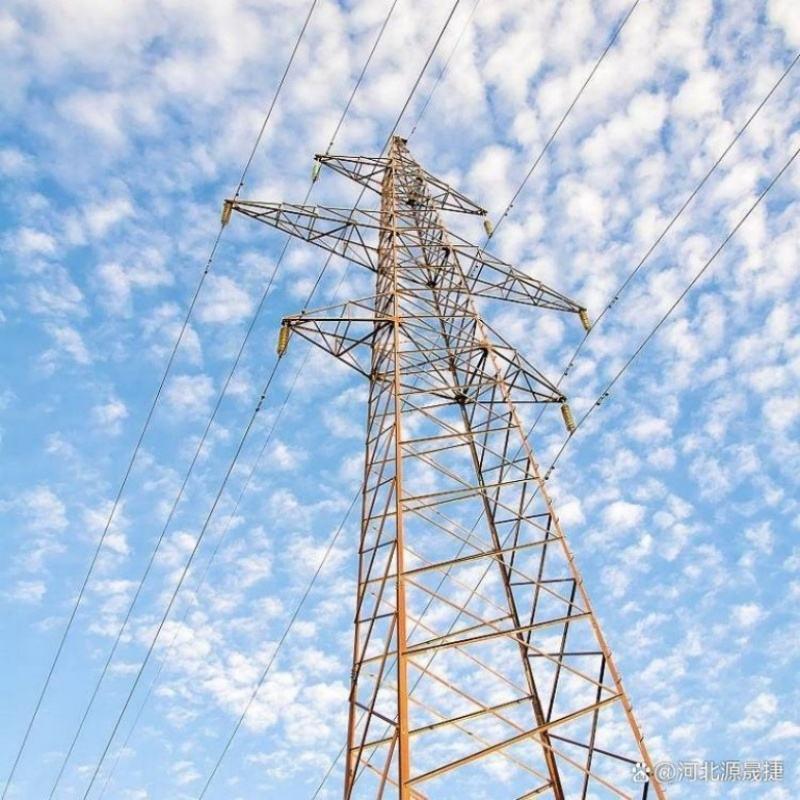
On long crossings, keeping an angle steel line tower in line is less about brute stiffness and more about controlling accumulated fit-up error. The lattice sections are bolted rather than welded, which gives crews useful adjustment at each splice, but it also means a small rotation at one joint can walk the towerhead several inches off the intended centerline before the structure even takes load.
Field alignment typically begins at the base and works upward with the main leg bolts left slightly loose until a theodolite or total station confirms the vertical axis and cross-arm orientation. Temporary guys or turnbuckles hold the section while the opposite face is pulled into plane. Only after the full body is within tolerance are the remaining bolts brought to final torque, usually in a diagonal sequence so the joint plates settle evenly instead of pinching one corner.
Once the conductors are strung, thermal bowing and uneven wind pressure can shift the top of the tower enough to affect mid-span clearance. That is why long-span angle steel towers are sometimes set with a small cold-curve offset in the opposite direction of the prevailing load. The final check is made under flat light or overcast conditions, when the sun is not pushing the steel one way, and the base nuts are locked only after that reading is stable.
What Happens in the Welding Jig Before Towers Reach the Field
Before a tower section ever leaves the fabrication hall, its shell cans and flanges are locked into a welding jig that sets the section's clocking, roundness, and flange alignment. The jig is more than a rack. It holds the door frame, ladder clips, and internal brackets in their correct relationship to the bolt holes. A bad setup here follows the tower into the field, where the crew will fight every bolt.
Fit-up usually starts by bringing the rolled cans around a central mast or end plates. Clamps and hydraulic rams pull the shell into round, and the gap along the longitudinal seam is checked with a taper gauge before tacking. Then the fitter walks the flanges with a tape and a square, checking cross-measurements and adjusting the strongbacks until the twist is gone. In many shops, this is also where the bolt-hole orientation is locked to the door opening and ladder bracket pattern, so the sections cannot be clocked wrong later.
Once the shell is tacked, the jig still has work to do. Some fixtures have copper or aluminum chill bars near the weld seam to pull heat out and keep the plate from scalloping. Others use preset stops for the root opening so welders do not have to guess at the gap. The jig itself is worth checking too. Worn clamp faces and bent locating pins can repeat the same small error across an entire batch of towers.
How a China-Based Fabrication Team Cuts Down Field Corrections
Field corrections usually start with a drawing that looks fine on screen but falls apart against existing site conditions. This team treats the first review as a fabrication exercise, not a design formality. They pull every connection, embedding, and edge condition into a separate checklist before raw material is cut, and anything that sits within a tight tolerance is called out to the client with a photo or a marked-up detail rather than left as a note in a transmittal.
The real difference happens in the workshop. Components that would normally be assembled for the first time on site are dry-fit, shimmed, and measured in a controlled bay. Anchor patterns are laid out on the floor at full scale, welded assemblies are checked for pull, and removable panels are test-hung before finishing. If a bolt hole is off by a few millimeters, it is easier to fix while the piece is still on a bench than when a crew is waiting on a lift.
Packing gets the same attention as fabrication. Crates are loaded by installation sequence, not by material type, and every part carries a label that matches the approved drawing index. That way a crew on another continent opens the right box at the right time and is not left sorting through loose hardware or guessing which bracket belongs on which elevation. Most of the remaining corrections are small punch-list items, not full rework.
Galvanizing Steps That Keep Transmission Structures in Service Longer
Hot-dip galvanizing does more than cover steel with a layer of zinc. Before immersion, degreasing, pickling, and fluxing remove mill scale, rust, and shop oils so the zinc can react with the base metal instead of sitting on top of surface contamination. The alloy layers that form during this reaction are tightly bonded and, in some zones, harder than the steel itself. That is why edge protection survives even where drilled holes and cut ends expose the substrate.
For transmission structures, the sequence of immersion time, withdrawal speed, and cooling matters at joints, base plates, and areas where moisture tends to collect. Controlling zinc drainage avoids thick drips and brittle edges that could crack under structural movement. A close visual inspection after cooling catches bare spots, lumps, and blisters before the steel leaves the yard, so weak points are corrected while the structure is still on the ground.
The longer lifespan comes from combining barrier protection with cathodic behavior. If the coating is scratched during hauling or erection, the surrounding zinc corrodes in preference to the exposed steel, keeping small damage from turning into structural loss. Many utilities therefore specify minimum coating thickness and rely less on field-applied paint for touch-ups. Proper surface preparation, controlled hot-dipping, and post-galvanizing checks keep lattice towers and poles in service well beyond what bare or lightly prepared steel could deliver.
Why Experienced Utilities Look Beyond Standard Drawings for Tangent Towers
Standard tangent tower drawings carry a quiet assumption: that the ground beneath every structure behaves the same way. Field veterans know this rarely holds. Soil resistivity shifts within a single right-of-way, access roads force unusual foundation offsets, and local wind microclimates can turn a textbook angle into a repeated maintenance headache. When a utility keeps ordering the same tangent assembly year after year, the savings on paper often reappear as crew hours, material patches, and early corrosion. Looking past the standard sheet is not a rejection of good engineering; it is an admission that standard drawings are a starting point, not a final answer.
Experienced utilities tend to treat tangent towers as variables rather than constants. They ask which spans actually stay tangent in service, where conductor tension creeps upward because of terrain, and whether the assumed clearance still works after five years of vegetation growth. A small change in body extension or crossarm width can remove a recurring clearance violation without altering the line’s overall character. Those decisions rarely come from a catalog. They come from walking the line, reading inspection photos, and remembering which tower numbers keep showing up on trouble tickets. Standard drawings cannot hold that memory, but a thoughtful utility can.
Cost comparisons miss the point when they only weigh initial steel weight and erection time. A tangent tower that fits the site reduces re-tensioning cycles, protects conductor hardware from unnecessary fatigue, and gives crews safer working positions during hot-stick maintenance. Utilities that have absorbed decades of failure data understand that the cheapest structure is the one you never have to revisit. So they adapt foundation depths, adjust ground wire peaks for local ice shedding, and specify coating systems based on actual exposure rather than a generic map. The result looks less uniform on a drawing index, but far more uniform in long-term reliability.
FAQ
The company handles detailing, CNC fabrication, and full trial assembly under one roof, so fit-up issues are caught before towers leave the yard. That leads to clean field assembly and fewer surprises during erection.
Accurate hole positions and controlled member lengths keep bolted connections tight and properly aligned. When joints fit without forcing, the structure distributes wind and conductor tension the way the design intended, which reduces long-term maintenance concerns.
Members are hot-dip galvanized after fabrication, normally to a minimum coating thickness of 86 microns. In coastal, industrial, or high-humidity corridors, coating thickness can be increased or supplemented according to the project specification.
Yes. The design team adjusts member sizes, bracing, and foundations around the specified voltage level, conductor type, wind zone, ice load, and altitude. Configurations commonly range from 35 kV distribution lines to high-voltage transmission corridors.
Material certificates are verified, dimensions are checked against approved drawings, and representative tower types undergo full-scale trial assembly. Galvanizing thickness and coating appearance are also inspected before packing.
Angle steel towers are easier to transport, handle, and repair in remote terrain because they arrive as bundled members and are bolted on site without heavy welding. That simplicity often lowers logistics costs and speeds up emergency rebuilds.
Production planning starts with in-house detailing and material lead times, so shortages are identified early. Tower sections are packed and marked by erection sequence, helping field crews find the right parts without delaying assembly.
They have been supplied for rural electrification, mountain crossings, substation tie lines, and long-distance high-voltage corridors where repeatable assembly and dependable delivery matter most.
Conclusion
Reliable transmission lines start long before the first tower leaves the yard. At this China-based angle steel tangent tower company, the focus sits on fabrication consistency: cutting, drilling, and fit-up are controlled tightly enough that assembly crews can predict how each joint will come together instead of wrestling with mismatched holes or bowed members on site. The welding jig work is treated as a separate quality gate, not an afterthought. Teams check diagonal alignment, bolt-hole placement, and leg geometry while the steel is still fixture-bound, which keeps long-span line towers tracking straight once they are erected and loaded. That kind of upstream control is what reduces expensive field corrections later.
The same practical mindset carries into protection and design review. Galvanizing is run as a process step with real inspection weight behind it, so coating thickness and surface condition are verified before shipment rather than assumed. In many cases, engineers also look past standard drawings for tangent towers and adjust details around terrain, wind exposure, and hardware fit. Experienced utilities tend to ask for those refinements because they know a small shop-floor adjustment can prevent years of alignment drift or corrosion touch-up. The result is a transmission structure that arrives ready to install, holds its line under load, and stays serviceable well beyond the first inspection cycle.
Contact Us
Contact Person: antor khan
Email: [email protected]
Tel/WhatsApp: 8613863903569
Website: https://www.qdabtower.com/